
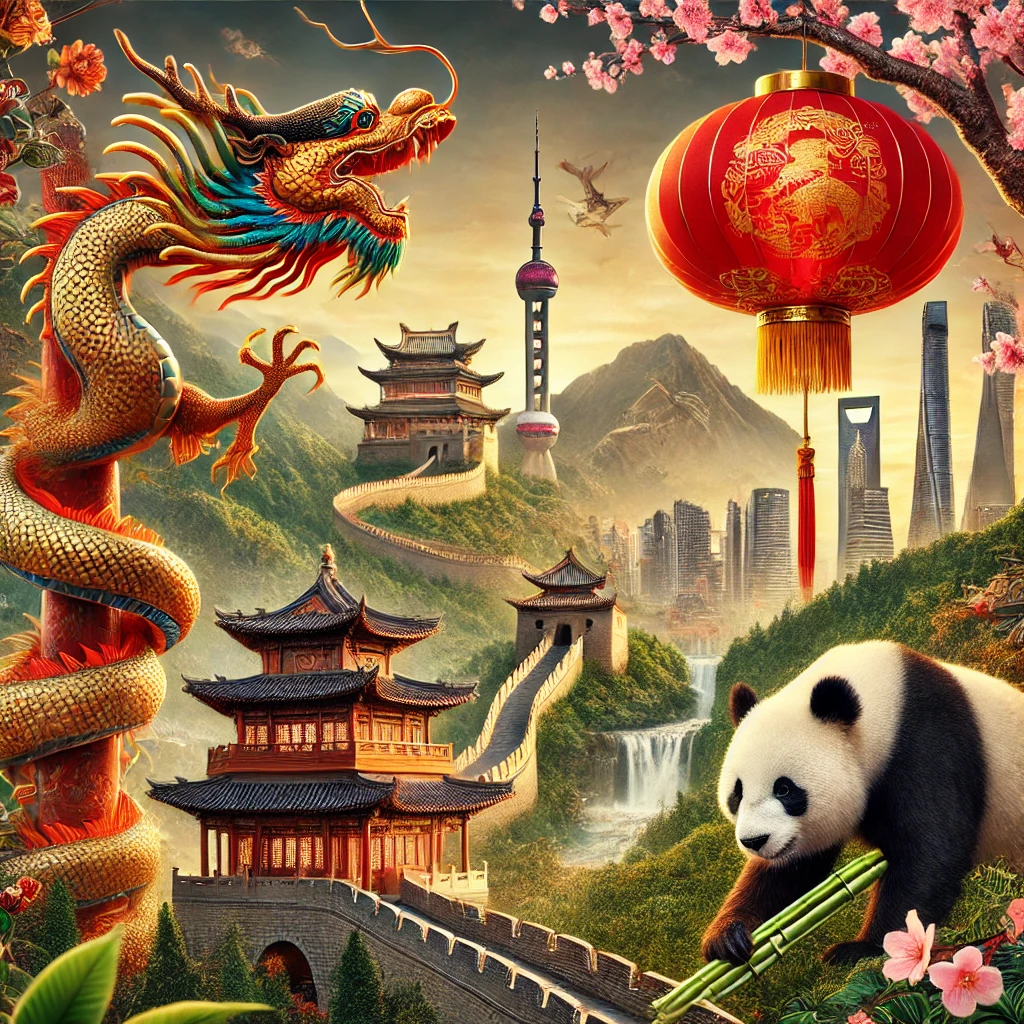
A Comprehensive Guide to China: Geography, Economy, Politics, Culture, Tourism, and Immigration
China is one of the world’s oldest civilizations, with a rich history, diverse geography, a booming economy, and a unique political system. As the world’s most populous country and second-largest economy, China offers numerous opportunities for travelers, businesspeople, and those seeking residency or citizenship. This guide covers every aspect of China, from its geography to pathways to citizenship, helping you understand why it is a significant global destination.
1. Geographical Overview of China
China is the third-largest country in the world, covering approximately 9.6 million square kilometers. It features diverse landscapes, from deserts and plateaus in the west to fertile plains and bustling megacities in the east.
Major Geographical Regions:
- Northeast China – Includes Heilongjiang, Jilin, and Liaoning provinces; cold winters, industrial hubs.
- North China – Includes Beijing, Tianjin, Hebei, Shanxi, Inner Mongolia; political and cultural centers.
- East China – Includes Shanghai, Jiangsu, Zhejiang, Fujian, Anhui, Shandong; economic and commercial hubs.
- Central China – Includes Henan, Hubei, Hunan; home to the Yangtze River and historical sites.
- South China – Includes Guangdong, Guangxi, Hainan; subtropical climate, financial hub (Shenzhen).
- Southwest China – Includes Sichuan, Yunnan, Guizhou, Chongqing, Tibet; mountainous and diverse culture.
- Northwest China – Includes Xinjiang, Gansu, Ningxia, Qinghai, Shaanxi; deserts, Silk Road history.
2. China’s Economy
China is the world’s second-largest economy and the largest manufacturing powerhouse. It has a GDP of over $17 trillion and leads in industries such as technology, finance, and exports.
Key Economic Sectors:
- Manufacturing – Electronics, textiles, steel, and automobiles.
- Technology – AI, semiconductors, 5G, and e-commerce (Huawei, Alibaba, Tencent).
- Finance – Shanghai and Shenzhen are global financial hubs.
- Agriculture – Largest producer of rice, tea, and pork.
- Tourism – China is a major travel destination with historical and modern attractions.
Major Economic Hubs:
- Beijing – Political and technological hub.
- Shanghai – Financial capital, business center.
- Shenzhen – Tech and innovation hub.
- Guangzhou – Manufacturing and trade.
- Chongqing – Rapid urban development.
3. Political System of China
China is governed by the Communist Party of China (CPC) under a one-party system.
- Government Structure:
- President (Head of State) – Currently Xi Jinping
- Premier (Head of Government) – Oversees policies and administration.
- National People’s Congress (NPC) – Legislative body.
- Foreign Policy:
- Active in global trade and diplomacy (Belt and Road Initiative).
- Maintains strict internet and media control.
- One-China policy regarding Taiwan.
4. Social and Cultural Aspects
China has a rich cultural history spanning over 5,000 years.
Language & Ethnic Groups:
- Official Language: Mandarin Chinese.
- Ethnic Diversity: 56 recognized ethnic groups, with Han Chinese making up 91%.
Traditions & Festivals:
- Chinese New Year – Largest celebration.
- Mid-Autumn Festival – Celebrating mooncakes and family reunions.
- Dragon Boat Festival – Commemorates poet Qu Yuan.
Modern Social Life:
- Technology-driven society (WeChat, Alipay, TikTok).
- Education System: Highly competitive (Gaokao exam).
- Work Culture: “996” system (9 AM – 9 PM, six days a week) in tech companies.
5. Tourism: Must-Visit Cities & Attractions
China is home to UNESCO World Heritage sites, modern skyscrapers, and natural wonders.
Top Cities and Their Attractions
- Beijing – The capital
- The Great Wall of China
- Forbidden City
- Temple of Heaven
- Shanghai – Financial hub
- The Bund
- Oriental Pearl Tower
- Shanghai Disneyland
- Xi’an – Ancient capital
- Terracotta Army
- Ancient City Wall
- Chengdu – Panda capital
- Chengdu Research Base of Giant Panda Breeding
- Jinli Street
- Guilin – Scenic beauty
- Li River cruise
- Longji Rice Terraces
- Zhangjiajie – Avatar mountains
- Tianmen Mountain
- Glass Skywalk
- Lhasa (Tibet) – Spiritual center
- Potala Palace
- Jokhang Temple
6. Pathways to Citizenship & Residency
China has a strict immigration policy, and obtaining citizenship is rare.
Ways to Visit China:
- Tourist Visa (L Visa) – For short-term visits.
- Business Visa (M Visa) – For trade and investment.
- Student Visa (X Visa) – For studying in China.
- Work Visa (Z Visa) – Requires sponsorship from a Chinese employer.
- Permanent Residency (Green Card) – Difficult to obtain, requires high qualifications or investment.
Pathway to Citizenship:
- Must live in China for 5+ years (permanent resident status).
- Must prove Chinese integration (language, culture, economy).
- China does not allow dual citizenship – must renounce original nationality.
Asylum in China:
- China does not have a formal refugee policy.
- Rare cases are considered, mostly for diplomatic reasons.
7. Jobs and Standard of Living
China offers job opportunities in teaching, technology, engineering, and trade.
Job Opportunities:
- Teaching English – High demand, salaries $2,000-$4,500/month.
- Tech Industry – AI, 5G, software, and gaming.
- Manufacturing & Trade – Export industries.
- Finance & Business – Shanghai, Shenzhen.
Cost of Living:
- Beijing & Shanghai – High living costs (~$1,500/month rent).
- Chengdu & Wuhan – Affordable ($600-$900/month).
- Rural Areas – Very cheap ($300-$500/month).
8. Why People Should Visit China
- Rich History & Culture – Over 5,000 years of civilization.
- Modern & Traditional Mix – Skyscrapers beside ancient temples.
- World-Class Cuisine – Peking duck, dim sum, hot pot.
- Advanced Infrastructure – High-speed trains, smart cities.
- Affordable Travel – Budget-friendly accommodations.
- Unique Natural Wonders – Karst mountains, desert landscapes.
- Shopping & Technology – Futuristic malls, AI-driven cities.
Final Thoughts
China is a global powerhouse with a deep historical background, economic strength, and modern infrastructure. Whether you want to explore its history, work in a booming industry, or study in prestigious universities, China offers countless opportunities. However, its immigration policies are strict, and adjusting to its culture and laws requires adaptability.
Travel advice (best places to visit, itinerary planning, visa requirements)?
Work opportunities (high-demand jobs, work visa process, salary expectations)?
Immigration & residency (how to get permanent residency, citizenship pathways)?
Studying in China (top universities, scholarships, student life)?
Business opportunities (starting a business, investment opportunities)?
1. Traveling to China: Visas, Best Places to Visit & Itinerary Planning
Visa Requirements & Types
To visit China, you need a visa unless you are from a country eligible for a visa-free entry (e.g., Singapore, Japan for short stays).
Common Visa Types for Tourists:
- Tourist Visa (L Visa) – Valid for 30-90 days.
- Business Visa (M Visa) – If you plan to attend business meetings.
- Transit Visa (G Visa) – If transiting through China for 24-144 hours (available in major cities).
How to Apply for a China Visa:
- Gather documents – Passport, photos, flight tickets, hotel booking.
- Submit application – Through the Chinese embassy or consulate.
- Processing time – Usually 4-7 business days.
Top Places to Visit in China
- Beijing – The capital, home to the Great Wall, Forbidden City, Temple of Heaven.
- Shanghai – Modern skyscrapers, The Bund, Oriental Pearl Tower, Disneyland.
- Xi’an – Terracotta Army, ancient city wall, Muslim Quarter.
- Chengdu – Giant Panda Research Base, spicy Sichuan food.
- Zhangjiajie – Avatar Mountains, glass bridge skywalk.
- Guilin & Yangshuo – Li River cruise, beautiful karst mountains.
- Tibet (Lhasa) – Potala Palace, Jokhang Temple, high-altitude adventure.
Recommended Itinerary (14 Days)
- Days 1-3: Beijing (Great Wall, Forbidden City).
- Days 4-6: Xi’an (Terracotta Army).
- Days 7-8: Chengdu (Pandas, hot pot).
- Days 9-10: Zhangjiajie (Avatar Mountains).
- Days 11-12: Guilin (Li River cruise).
- Days 13-14: Shanghai (The Bund, skyscrapers).
2. Working in China: Jobs, Salaries & Work Visa
High-Demand Jobs in China (for Foreigners)
- Teaching English – $2,000-$4,500/month, easiest job for foreigners.
- Technology (AI, IT, Software Engineering) – $5,000-$10,000/month.
- Finance & Business (Banking, Accounting) – $4,000-$8,000/month.
- Manufacturing & Supply Chain – If you have industry experience.
- Hospitality & Tourism – Hotel management, high-end restaurants.
Getting a Work Visa (Z Visa)
To work legally, you must:
- Get a job offer from a company that can sponsor your visa.
- Employer applies for a Work Permit on your behalf.
- Apply for a Z Visa at the Chinese embassy in your country.
- Enter China & get a Residence Permit (valid for 1-5 years).
Important: Many foreigners first enter China on a tourist visa and then switch to a work visa after securing a job.
3. Immigration & Residency: Pathways to Living in China
How to Get Permanent Residency (China Green Card)
- Investment Route: Invest at least $500,000 – $2 million in China.
- Highly Skilled Talent: Professors, researchers, high-tech experts.
- Marriage to a Chinese Citizen: Requires 5+ years of marriage.
- Long-Term Work Residency: If you work in China for 5+ years with a stable job.
Pathway to Chinese Citizenship
- China does NOT allow dual citizenship – you must renounce your original nationality.
- You must live in China for 5+ years, show cultural integration, and have a clean legal record.
Note: Gaining Chinese citizenship is extremely difficult; most foreigners stay on permanent residency instead.
4. Studying in China: Top Universities & Scholarships
Best Universities for International Students
- Tsinghua University – Best for engineering, tech.
- Peking University – Top humanities & business school.
- Fudan University (Shanghai) – International business hub.
- Zhejiang University – Strong in medicine & engineering.
- Shanghai Jiao Tong University – Great for STEM fields.
China Scholarships for Foreign Students
- Chinese Government Scholarship (CSC) – Covers tuition, accommodation, and stipend.
- Confucius Institute Scholarship – For Chinese language learners.
- University-specific Scholarships – Many top universities offer funding.
How to Apply:
- Choose a university and program.
- Apply online via the CSC Scholarship portal.
- Submit documents (transcripts, recommendation letters).
- If approved, apply for a Student Visa (X Visa).
5. Business & Investment in China
How to Start a Business in China
- Choose a Business Structure:
- Wholly Foreign-Owned Enterprise (WFOE) – Full control, but expensive.
- Joint Venture (JV) – Partner with a local Chinese company.
- Representative Office (RO) – Limited to market research only.
- Register Your Business:
- Choose a Chinese business name.
- Get a business license from the State Administration for Market Regulation (SAMR).
- Open a Chinese bank account.
- Investment Sectors in China:
- E-commerce & Tech – Growing rapidly (Alibaba, JD.com).
- Manufacturing & Export – China is the “world’s factory”.
- Real Estate – Foreigners can buy property in some cities.
How to Get a Business Visa (M Visa)
- Find a Chinese business partner or company to invite you.
- Apply at the Chinese Embassy with a business invitation letter.
- M Visas are valid for 30-180 days.
6. Standard of Living in China
Cost of Living in Major Cities
Quality of Life:
- Healthcare: High-quality but expensive (private hospitals).
- Public Transport: Cheap, efficient (metro, high-speed trains).
- Internet & Social Media: Restricted (use VPN for Google, Facebook).
Final Thoughts: Why China?
✔ Economic Superpower – Job & business opportunities.
✔ Affordable Travel – Budget-friendly tourism.
✔ Rich Culture & History – 5,000+ years of civilization.
✔ Modern Infrastructure – High-speed trains, AI cities.
✔ Dynamic Lifestyle – Unique blend of tradition & tech.
Would you like a more detailed guide on any specific aspect (visas, job hunting, travel tips, etc.)? Let me know!